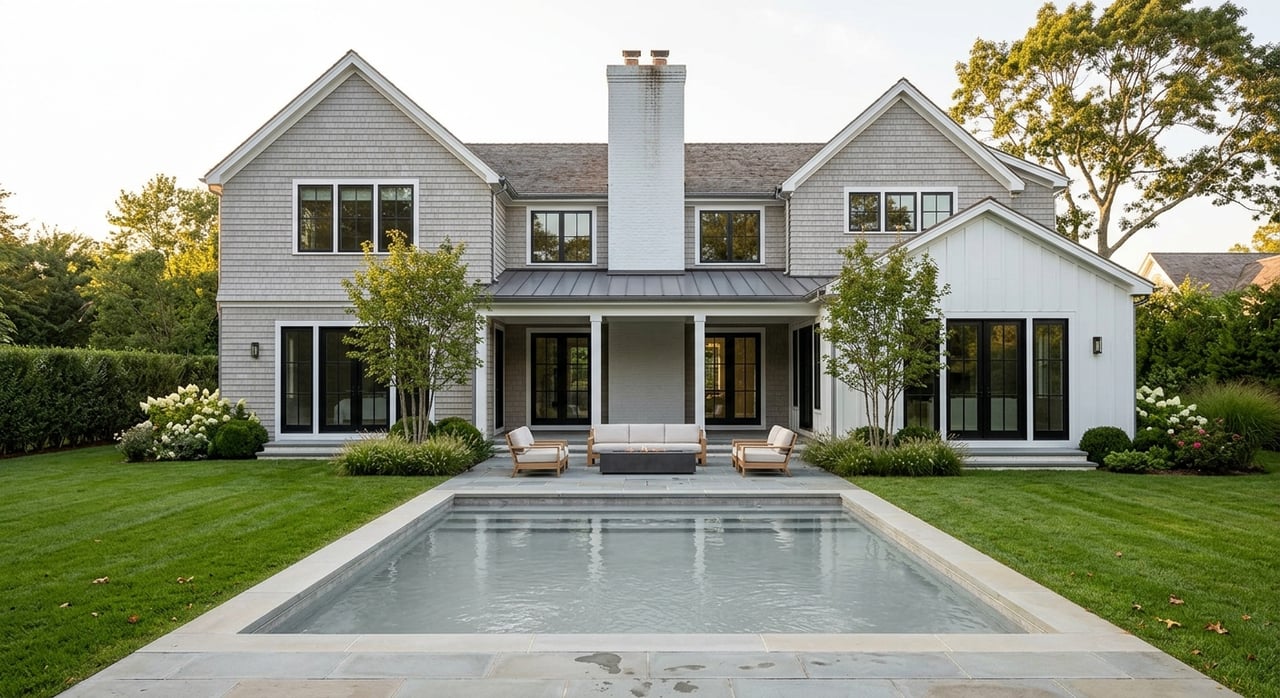
Building New In Sagaponack: What Buyers Should Evaluate
April 2, 2026
April 2, 2026
If you are thinking about building new in Sagaponack, it is easy to focus on the house you want and overlook the land realities that will shape what you can actually create. In a small, high-value market like this one, a beautiful rendering means very little until you understand zoning, overlays, wetlands, flood rules, and design review. The good news is that careful due diligence can help you protect both your vision and your investment. Let’s dive in.
Sagaponack is a small incorporated village in Southampton Town, Suffolk County, located between Bridgehampton and Wainscott, with about 4.56 square miles according to the Village of Sagaponack. That limited footprint is part of what makes the market so exclusive, but it also means every parcel has to be evaluated very closely.
Recent Hamptons market reports show just how thin and volatile the Sagaponack market can be. Miller Samuel reported median sale prices of $7.4 million in Q1 2025, $5.4625 million in Q2 2025, and $5.8 million in Q3 2025, with only 5 to 12 closed sales per quarter. When sales volume is that low, one standout closing can shift the numbers quickly, which is why parcel-specific buildability often matters more than broad market averages.
Before you think about design, you need to know exactly which zoning district applies to the property. The village code establishes R-40, R-80, R-120, and overlay districts, and in residence districts, a lot may not contain more than one single-family detached dwelling.
That one rule alone can shape your strategy if you are considering a guest structure, compound layout, or future flexibility. It is also why you want to confirm the exact district and any overlays before you price the opportunity.
The village dimensional table sets the basic framework for what a site can support. In R-40, the minimum lot area is 40,000 square feet with 150 feet of minimum width, a 60-foot front yard, 20-foot minimum side yards with 60 feet total, and a 70-foot rear yard.
In R-80 and R-120, the minimum lot sizes increase to 80,000 and 120,000 square feet, with minimum widths of 175 and 200 feet. These districts also require deeper setbacks, including 80-foot front yards, 30-foot minimum side yards with 75 feet total, and 100-foot rear yards.
Those setbacks can shrink the usable building envelope faster than many buyers expect. A large parcel may still have a surprisingly narrow or constrained area where the main house, pool, septic, and accessory features can legally fit.
Height is also controlled. The village allows a maximum height of 32 feet if the roof pitch is 4/12 or steeper, or 25 feet if the roof is flatter, based on the same dimensional regulations table.
Floor area minimums vary by district and building type, and the code also caps gross floor area at 12,000 square feet for a dwelling and 13,800 square feet for the dwelling plus all attached and detached roofed structures. If you are planning a large estate home, pool house, or other roofed improvements, these caps need to be part of the conversation from day one.
One of the most important details buyers miss is lot coverage. In Sagaponack, lot coverage is tiered by lot size and does not rise in a simple straight line with acreage.
That matters because a very large parcel does not automatically mean unlimited hardscape, structures, and outdoor improvements. In the largest bracket shown, lots of 425,000 square feet and up are capped at 80,000 square feet of total lot coverage, which can directly affect driveways, courts, terraces, pools, and accessory buildings.
Overlay districts can dramatically change what looks possible on paper. The village code includes overlays for tidal wetlands and ocean beach, tidal floodplain, and agriculture, all of which can affect development strategy and long-term value.
For larger parcels, the Agricultural Overlay District deserves special attention. If a lot wholly or partly in that overlay is subdivided, the code requires open-space preservation of at least 35 percent in R-40, 50 percent in R-80, and 65 percent in R-120.
The village also states an intent to preserve at least 80 percent of remaining farmland for agricultural production. If you are buying with subdivision in mind, this is not a detail to review later. It is a front-end diligence issue.
Wetlands are one of the biggest reasons a promising site can become a difficult one. Under the village code, activity in a wetland or within 200 feet of a wetland boundary is permit-controlled.
The rules also contemplate buffer zones of 100 feet for turf or landscape disturbance, 125 feet for structures, and 150 feet for wastewater systems, with reduced buffers only in some developed-property situations. Once those setbacks are layered onto zoning setbacks, the practical buildable area may look very different from the tax map.
A wetlands permit application may require survey information showing wetlands, topography, wells, septic systems, and FEMA flood zone designation. That tells you something important as a buyer: a quick visual walk of the site is not enough.
If a parcel has wetlands exposure, you want to understand how that affects the house location, drainage design, wastewater placement, and landscaping scope before you commit. In Sagaponack, those issues can influence value as much as the architecture itself.
If the property is in a coastal setting, you also need to review coastal erosion regulations. In the Coastal Erosion Hazard Area, no regulated activity may occur without a coastal erosion management permit, and those rules supersede conflicting underlying zoning.
The permit standard requires the activity to be reasonable and necessary, not likely to cause a measurable increase in erosion, and designed to minimize adverse effects on natural protective features and habitat. For buyers considering ocean-adjacent or otherwise sensitive land, this can become a major factor in both timing and design feasibility.
Floodplain compliance is another essential checkpoint. In areas of special flood hazard, development is unlawful without a floodplain development permit, and the application must show existing and proposed structures, fill, drainage, and related information.
In coastal high-hazard V zones, the code adds elevated-construction and breakaway-wall standards. These requirements can affect everything from foundation design to finished-floor elevations to the visual feel of the final home.
The village’s subdivision and design standards require stormwater to recharge to the subsurface groundwater reservoir rather than discharge directly to surface waters or marshes. The standards also advise minimizing cuts, fills, and disturbance of natural terrain.
In practical terms, you should think about the legal building envelope only after septic, drainage, wetland, bluff, and flood constraints are all layered together. A parcel that looks generous in acreage may become much tighter once all of those systems are mapped out.
In Sagaponack, new construction is not simply a matter of meeting dimensional rules. The Architectural and Historic Review Board reviews all building permit applications for buildings or other structures, with limited exceptions.
That means design character, visual impact, and siting can all become part of the process. If you are planning a teardown or custom build, you should be prepared for an added layer of review beyond standard zoning compliance.
The code includes specific guidance for gates and gateposts. It emphasizes avoiding excessive ornamentation, limiting structural and visual mass, maintaining compatibility with surrounding properties and neighborhood character, and placing the gate as far back from the street as reasonably possible, according to the AHRB regulations.
The code also bars residential driveway gates and gateposts on certain historic-district street segments, including parts of Sagg Main Street, Hedges Lane, Personage Lane, Gibson Lane, Daniels Lane, Sagaponack Road, and Bridge Lane. If your vision includes a strong arrival sequence, this is worth checking before you assume it is allowed.
If the existing structure is historic or the property sits within the historic district, demolition and new construction can become more complex. Under the village code, the board may classify a structure as historic based on special character, architectural style, unique location, craftsmanship, or historic significance, and new construction in a historic district must be compatible with nearby properties.
A demolition applicant may also need to prove hardship, including lack of reasonable return and failed preservation efforts. If you are buying a teardown candidate, this is one of the most important items to clarify before closing.
Sagaponack sales illustrate an important point: not all new construction is valued the same way. Recent reporting from 27east noted a new 8,000-square-foot home sold preconstruction for $6 million, while a newly built 9,000-square-foot residence sold for $6.4 million.
By contrast, a 1.45-acre estate built in 2008 sold for $9.5 million, an 8-acre oceanfront estate sold for $19.8 million, and a 3.5-acre oceanfront compound was listed at $89 million. The takeaway is clear: in Sagaponack, land quality, frontage, acreage, views, and redevelopment optionality can matter more than whether the house is brand new.
If you are evaluating land, a teardown, or a newer spec opportunity, focus on the issues that drive buildability and long-term value:
In a market this specialized, due diligence is where great decisions are made. If you want a sharp read on a specific parcel or teardown candidate in Sagaponack, working with someone who understands both the local code framework and the luxury market can save you time, money, and frustration.
If you are considering a build, teardown, or strategic purchase in Sagaponack, I can help you evaluate the opportunity with a local, market-aware lens. Connect with Geoff Gifkins for a private consultation.
Stay up to date on the latest real estate trends.
Etiam non quam lacus suspendisse faucibus interdum. Orci ac auctor augue mauris augue neque. Bibendum at varius vel pharetra. Viverra orci sagittis eu volutpat.